


Running a Caravan Air Conditioner Off Battery: What It Actually Takes
Running a Caravan Air Conditioner Off Battery: What It Actually Takes

It’s 38 degrees, you’re at a free camp with no power, and the van is an oven. You want the air con on, and you don’t want to listen to a generator all afternoon. Running a caravan air conditioner off battery is possible now that lithium setups have grown, but it takes more than a bigger battery. You need the right battery bank, the right inverter, and realistic expectations about how long it will run.
Below are the numbers, so you can work out how close your current setup is, or what you’d need to change before summer.
How Much Power Does a Caravan Air Conditioner Draw?
Rooftop reverse-cycle units on Australian caravans mostly sit somewhere between 2kW and 3.5kW of cooling capacity, and their power draw follows that. A smaller unit might settle at around 800–900 watts once the compressor is running. A 3.5kW unit can pull closer to 1,400W. Both spike well above that for a moment when the compressor starts. Nothing else in the van comes close: your fridge, lights and water pump combined are a fraction of it.
On a 12V system, and allowing 10–15% for inverter losses, that’s roughly 80–130 amp-hours for every hour the compressor runs, depending on the unit. The compressor does cycle off once the van has cooled, so the average over an evening is a bit lower. Your unit’s spec plate lists its rated input power, and that’s the figure to plan around.
What You Need in the Battery Bank

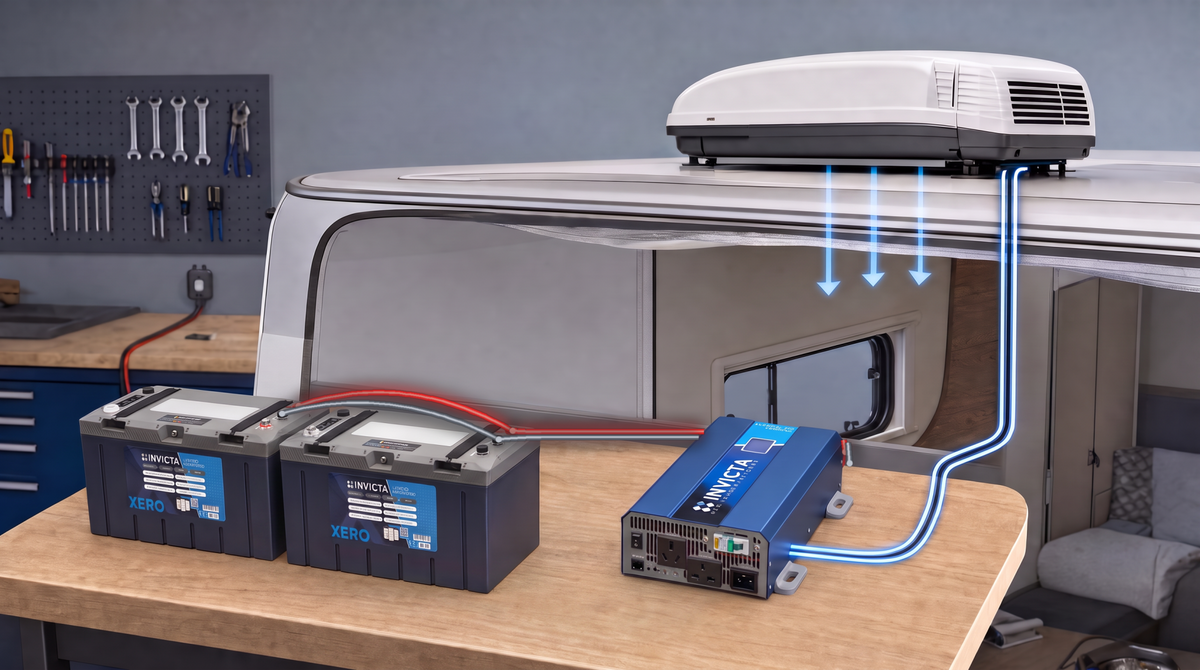
This is the part most people underestimate when they start looking at running caravan air conditioner off battery setups, and it’s where the “lithium battery for caravan air con” question gets answered. A single 100Ah AGM or lead-acid battery won’t handle it. At this draw you’d flatten it in well under an hour and shorten its life in the process. LiFePO4 copes with deep, repeated, high-current discharge much better, which is why these setups are built on lithium.
Treat about 200Ah as the bare minimum. 300–400Ah is a more practical starting point if you want a few hours of cooling and still have enough left for the fridge and lights overnight. That’s usually two or more batteries wired in parallel.
The battery management system (BMS) matters as much as the capacity. It stops the cells being drained below a safe voltage and limits current, so the battery can supply a heavy continuous load without shutting itself down or wearing out early. Check the battery’s rated continuous discharge current against what the inverter will draw. A battery with enough amp-hours on paper can still trip its BMS if the compressor’s start-up surge asks for more current than it’s rated to deliver.
Running Caravan Air Conditioner Off Battery: Realistic Run Times
Take a mid-sized unit using about 100Ah an hour. A 300Ah lithium bank gives you roughly two to three hours of cooling before you’re eating into reserve, and less if the fridge, lights and phone chargers run off the same bank. That’s enough to cool the van down before bed or get through the worst of the afternoon. It won’t run all night unless you have a much larger bank, or solar has topped the bank back up during the day.
Solar won’t keep up with an air conditioner running hard in direct sun. A typical caravan roof array adds a useful amount over a whole day, but nowhere near enough to offset a 1,000W-plus load in real time. Most people who do this regularly run the air con in shorter bursts when they need it, and let the solar refill the bank in between.
Inverter and Wiring Considerations
A standard rooftop unit runs on 240V, so you need a pure sine wave inverter rated comfortably above the unit’s running wattage. It also has to handle the start-up surge, which can briefly hit three to five times the running draw on a unit without a soft-start module, and much less on one that has it. A 2,000W inverter covers many soft-start units, and plenty of installers go to around 3,000W for headroom. An undersized inverter is one of the most common reasons a decent battery setup trips out the moment the compressor kicks in.
Cable size matters too. Undersized or long cable runs between the battery and inverter cause voltage drop, and a battery bank that looks big enough on paper will then underperform.
Safety, Standards and Getting It Right
This is a high-current system, so it isn’t a job to wire up with whatever’s lying around the shed. In Australia, AS/NZS 3001.2:2022 sets the rules for electrical installations in caravans, motorhomes and camper trailers, including batteries and inverters, and it has applied to new installations since November 2023. It requires lithium batteries to comply with AS IEC 62619, and they can’t go in the living area unless they’re in a sealed enclosure, or in a space that’s sealed off from the cabin and vented outside.
LiFePO4 is much more thermally stable than other common lithium chemistries, but every lithium battery has a charge and discharge temperature range set by its manufacturer. Most problems come from running a system outside that range, or from an installer who hasn’t worked with high-current 12V systems before.
If you’re building or upgrading a setup for running caravan air conditioner off battery, size the battery, inverter, cabling and solar together rather than one piece at a time. Invicta Lithium batteries have a built-in BMS designed for sustained high-current use like this. If you’re not sure your current bank can handle a rooftop air conditioner, talk it through with your installer before you find out 200km from the nearest powered site on a 40-degree day.
https://www.sealedperformance.com.au/range/invicta-pure-power-inverters/