


How Long Do Lithium Batteries Last in a Caravan?
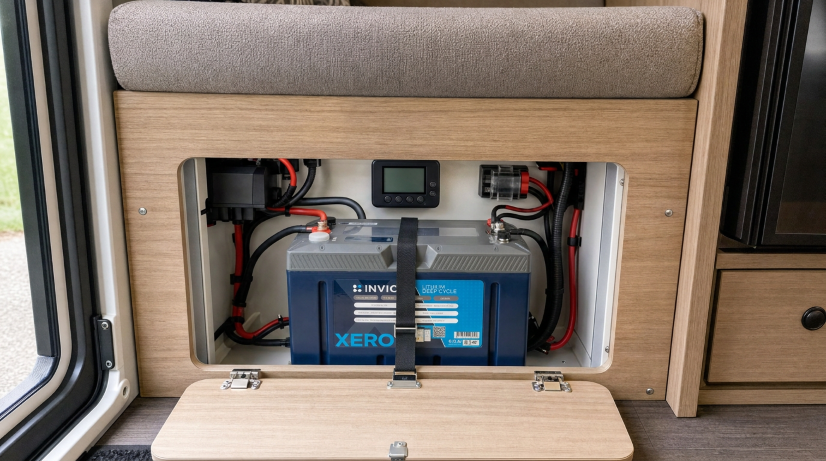
How Long Do Lithium Batteries Last in a Caravan or 4WD?
It’s one of the first questions anyone asks before spending real money on a lithium setup, and it’s not a bad question — how long do lithium batteries last, once they’re doing actual work in a caravan, camper or 4WD dual battery system? The honest answer is “longer than the lead-acid or AGM battery it replaced, provided a few basic things go right.” The less honest answer is a single number on a spec sheet that doesn’t account for how the battery is actually used, charged and stored.

The Number on the Box vs Real-World Life
Lithium (LiFePO4) cells are typically rated for several thousand charge cycles before their capacity drops to around 80% of new — a figure manufacturers quote at a controlled reference temperature, usually 25°C. That rated figure is useful for comparing cells, but it’s a lab number, not a promise about a specific van’s battery bay in the middle of an Australian summer.
Two things push the real-world answer for how long lithium batteries last well above the old lead-acid benchmark of a few hundred cycles: the chemistry itself is far more tolerant of deep, repeated discharge, and a properly designed battery management system (BMS) stops the pack from ever being pushed into the conditions that actually cause premature wear. Cycle life and calendar life both matter here — a battery can be brand new by cycle count and still be years old by calendar time, and LiFePO4 chemistry is generally considered to hold up well over both, commonly cited in the 8-10+ year range for calendar life in normal use.
Why the BMS Is Doing More Work Than People Realise
Every quality lithium battery built for RV or 4WD use has a battery management system built into the case, and it’s the single biggest reason lithium battery lifespan tends to outperform older chemistries in real conditions. The BMS constantly monitors individual cell voltages and pack temperature, and it steps in before problems become damage — cutting charge current if the pack gets too hot, cutting output if a cell is discharged too low, and balancing individual cells against each other so the whole pack ages evenly rather than one weak cell dragging the rest down.
That protection matters because the traditional advice around depth of discharge — the old rule of only using a set percentage of a battery’s capacity to protect its lifespan — is becoming less strict as BMS design improves. Some manufacturers still recommend keeping cycling within a moderate window for maximum longevity, while others now design their BMS to safely handle a full range of use, on the basis that the electronics will protect the pack long before the cells themselves are stressed. Either way, the lesson for a caravan or touring setup is the same: the BMS isn’t a minor spec-sheet line item, it’s actively extending the battery’s working life every single day it’s connected.
What Actually Shortens Lithium Battery Life
Given decent components, the biggest variable in how long lithium batteries last isn’t the battery — it’s heat. Cycle life figures drop noticeably at higher operating temperatures compared to the same cells run at a moderate reference temperature, which is directly relevant to anything mounted in a caravan tunnel boot or under a canopy that sits in direct sun through a Queensland or WA summer. A [depth-of-discharge and cycle life breakdown for LiFePO4 cells](https://cleversolarpower.com/depth-of-discharge-lifepo4-batteries/) lays out how sharply rated cycle counts can fall once a battery is regularly cycled at high ambient temperature rather than a controlled 25°C.
Beyond heat, the other practical factors that shorten real-world lithium battery lifespan are:
- Charging with the wrong profile. Lithium needs a charge algorithm suited to LiFePO4, not one borrowed from an AGM setup — mismatched charging is one of the more common causes of early degradation in DIY installs.
- Long-term storage at full charge, in the heat. If a van is off the road for months over summer, storing the battery at a partial charge in a cooler spot is kinder to it than leaving it at 100% baking in a closed compartment.
- Poor ventilation around the battery bay, which compounds the heat problem above.
Cheap or mismatched BMS electronics, which is really a way of saying: the protection circuit is only as good as its design, and it’s worth knowing what’s actually inside the case being bought.

Getting the Most Out of the Investment
None of this means lithium batteries need to be babied. Compared to flooded or AGM batteries, they’re dramatically more tolerant of the kind of hard, repeated use a touring setup demands — faster charge acceptance, far more usable capacity for the same physical size, and a BMS doing constant background protection that older chemistries simply don’t have. The practical takeaway on how long lithium batteries last is less about any single number and more about a handful of habits: keep the battery reasonably cool, use a charger designed for LiFePO4, and don’t leave it sitting fully charged in a hot compartment for months at a time.
Invicta Lithium batteries are built with quality cells and a properly engineered BMS specifically for the demands of caravan, marine and 4WD use — the kind of setup that’s designed to be installed once and genuinely forgotten about, trip after trip, for years. If a lithium upgrade is on the cards for the next touring season, it’s worth looking at what’s actually inside the case, not just the amp-hour number on the label.
https://www.thevanconversion.com/post/dc-to-dc-charger-buying-guide